


Ex-proof is a common trade term derived from "explosion" and "proof"; it is used for explosion-protected equipment. In a plant where flammable gas, vapour, mist or dust is present, an ordinary lamp, socket or junction box can trigger an explosion through a spark or a hot surface. For this reason, only equipment designed and certified for explosive atmospheres is used in these areas.
Where do explosive atmospheres form?
The Turkish regulation defines an explosive atmosphere as a mixture of flammable substances in the form of gas, vapour, mist or dust with air under atmospheric conditions, in which combustion spreads to the entire unburned mixture after ignition by any ignition source. Such atmospheres do not occur only in oil and chemical plants. The application guide of the Turkish Ministry of Labour and Social Security lists the following examples:
- Refineries and the chemical industry (hydrocarbons, solvents, flammable gases)
- Natural gas installations, biogas and wastewater treatment plants
- Spray painting areas (solvent vapour)
- The pharmaceutical industry (solvents and powdered active ingredients)
- Food and feed production (flour, sugar, grain dust), the wood and furniture industry (wood dust)
- Metalworking (metal dust) and thermal power plants (coal dust)
According to the same guide, electrical sparks and hot surfaces of electrical equipment can be ignition sources even at low voltages. Sparks occur when circuits are opened and closed, at loose connections and from stray currents. Ex-proof equipment exists to prevent these sources from meeting an explosive atmosphere.
How does ex-proof equipment provide protection?
A common misconception is that an ex-proof enclosure is built to withstand an explosion outside it. In fact, the aim is that the equipment itself does not become an ignition source. The IEC 60079 series of standards achieves this through different protection types:
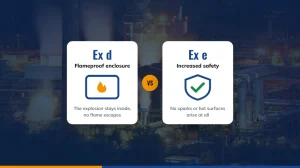
- Flameproof enclosure (Ex d): An enclosure strong enough to withstand an internal explosion; narrow flame paths at the joints prevent the flame from passing to the surrounding atmosphere.
- Increased safety (Ex e): Equipment that does not produce sparks in normal operation is made even safer with additional measures (insulation distances, a robust enclosure, limited temperature).
- Intrinsic safety (Ex i): The electrical energy in the circuit is limited to a level that cannot ignite the atmosphere.
- Pressurization (Ex p) and encapsulation (Ex m): The explosive atmosphere is prevented from reaching the ignition source by internal overpressure or by potting in casting resin.
- Dust ignition protection by enclosure (Ex t): Protection in dust atmospheres through a dust-tight enclosure and limited surface temperature.
Details of these types and their standard numbers are given in a table in our article Definition of Explosion Protection.
Zones, categories and equipment protection level (EPL)
Which equipment may be used where is determined by area classification, based on how often and for how long an explosive atmosphere is present. The employer carries out the classification and documents it in the "explosion protection document". The annexes of the regulation give the equipment category permitted in each zone; in IEC standards the same requirement is expressed by the equipment protection level (EPL).
| Zone | Explosive atmosphere | Permitted category | Minimum EPL required |
|---|---|---|---|
| Zone 0 (gas) | Present continuously, for long periods or frequently | 1G | Ga |
| Zone 1 (gas) | Likely to occur occasionally in normal operation | 1G or 2G | Gb |
| Zone 2 (gas) | Not likely in normal operation; if it occurs, only for a short period | 1G, 2G or 3G | Gc |
| Zone 20 (dust) | Dust cloud present continuously, for long periods or frequently | 1D | Da |
| Zone 21 (dust) | Likely to occur occasionally in normal operation | 1D or 2D | Db |
| Zone 22 (dust) | Not likely in normal operation; if it occurs, only for a short period | 1D, 2D or 3D | Dc |
Higher-level equipment can also be used in a lower-risk zone; the reverse is not allowed. For example, a luminaire suitable for Zone 1 can be used in Zone 2, but not in Zone 0.
How to read the Ex marking
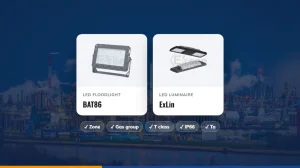
The label of an ex-proof product states where it may be used by means of abbreviations. Take the "Ex db IIB+H2" marking on the BAT86 ex-proof LED floodlight on our website as an example:
- Ex: Equipment certified for explosive atmospheres.
- db: Flameproof enclosure (d), protection level "b". Protection level a indicates very high, b high and c normal safety; level "b" corresponds to Gb and use in Zone 1.
- IIB+H2: Suitable for gas group IIB and additionally for hydrogen. The gas groups are IIA (e.g. propane, acetone), IIB (e.g. ethylene) and IIC, the most easily ignited (hydrogen, acetylene, carbon disulphide). For dust, the equivalent groups are IIIA (combustible flyings), IIIB (non-conductive dust) and IIIC (conductive dust).
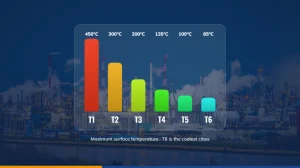
The label also shows the temperature class. The maximum surface temperature of the equipment must remain below the ignition temperature of the gas present:
| Temperature class | Maximum surface temperature |
|---|---|
| T1 | 450 °C |
| T2 | 300 °C |
| T3 | 200 °C |
| T4 | 135 °C |
| T5 | 100 °C |
| T6 | 85 °C |
The “Ex işaretinin anlamı” (What the Ex marking means) tool on our product pages explains each part of the label in this way, and the “Sahanıza uygun mu?” (Right for your site?) table shows in which zones the product can be used.
How is an ex-proof product certified?
The manufacturer's statement alone is not enough to call a product "ex-proof"; the product must be tested and certified to the relevant standards. In the European Union, the product side is governed by Directive 2014/34/EU (ATEX). The directive has applied since 20 April 2016 and replaced the former Directive 94/9/EC. In Türkiye, its equivalent is the "Regulation on Equipment and Protective Systems Intended for Use in Potentially Explosive Atmospheres (2014/34/EU)", published in Official Gazette No. 29758 of 30 June 2016, which transposes Directive 2014/34/EU into Turkish law. Under this regulation, the CE marking on the product is followed by the specific explosion protection marking together with the equipment group and category. Where a notified body is involved in production control, its identification number appears next to the CE marking.
On the workplace side, the "Regulation on the Protection of Workers from the Risks of Explosive Atmospheres" (30 April 2013, Official Gazette No. 28633), the Turkish counterpart of Directive 1999/92/EC, applies. The employer assesses the explosion risk, classifies the hazardous areas and shows in the explosion protection document that the equipment has been selected to suit these areas. International projects also frequently require the IECEx certification system, which is based on IEC standards. For more on ATEX, see our article What is an ATEX certificate?.
The right product with Eksen Mühendislik
To choose the right ex-proof product, you first need to know the zone of your site, the gas or dust group and the required temperature class. With this information you can select a suitable product from our ex-proof lighting, control, distribution and junction boxes and ex-proof cable glands. If you are unsure, contact us with your project details.
Sources
- Regulation on Equipment and Protective Systems Intended for Use in Potentially Explosive Atmospheres (2014/34/EU), Official Gazette 30.06.2016, No. 29758 (in Turkish)
- Regulation on the Protection of Workers from the Risks of Explosive Atmospheres, Official Gazette 30.04.2013, No. 28633 (in Turkish)
- Turkish Ministry of Labour and Social Security (ÇSGB), Application Guide on the Protection of Workers from the Risks of Explosive Atmospheres (2015, revised 2024) (in Turkish)
- European Commission, Equipment for potentially explosive atmospheres (ATEX)
- IECEx, Standards (IEC 60079 series)
- IECEx International Conference 2018, Overview of Explosion Protection Techniques (BARTEC)
 Home
 Products
 Whatsapp
 Sidebar
 Top