


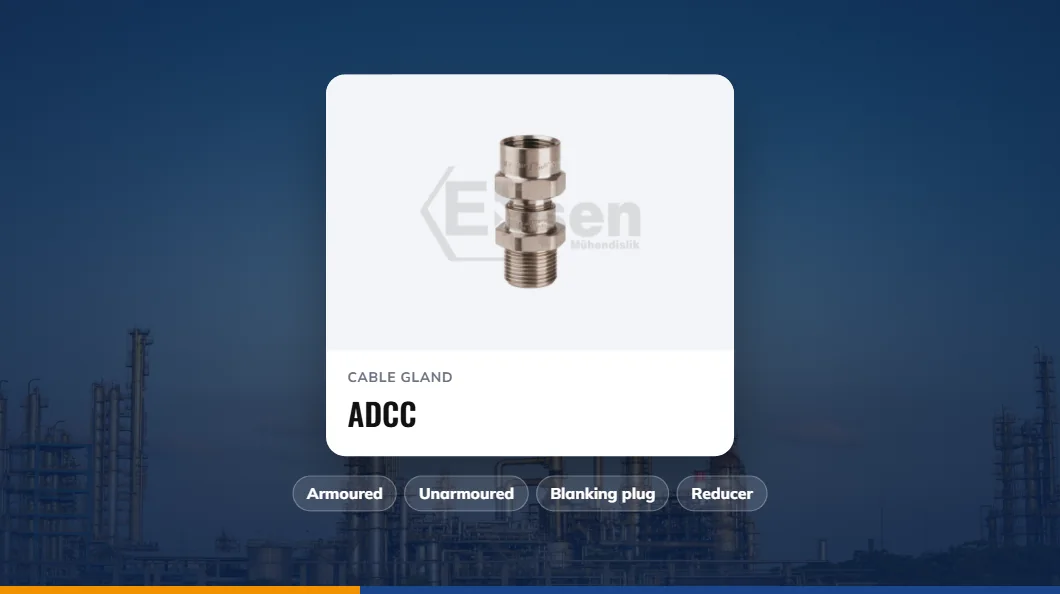
A certified luminaire or junction box can lose its protection if an unsuitable cable gland is fitted to its cable entry. A cable gland may look like a small part, but it is part of the equipment's protection type and must be selected with its own certificate. In this article we go through the criteria that determine the cable gland in order.
Five criteria that determine the cable gland
1. The protection type of the equipment
The first question is the protection type of the enclosure to which the cable gland will be fitted. According to the cable gland selection table in IEC 60079-14:
| Protection type of the equipment | Permitted cable glands, adaptors and blanking plugs |
|---|---|
| Flameproof enclosure (Ex d) | Ex d only |
| Increased safety (Ex e) | Ex e or Ex d |
| Dust protection by enclosure (Ex t) | Ex t |
With an Ex d enclosure, the type of cable gland also matters. The standard specifies a barrier (compound-filled) Ex d cable gland or, under certain cable conditions, a seal-type Ex d cable gland. The 6th edition of IEC 60079-14, published in August 2024, contains a flowchart for this selection. The flowchart includes criteria such as hydrogen or gas group IIC, the length of the connected cable and an enclosure volume exceeding 2000 cm³.
The cable gland itself is also an Ex product. Ex d cable glands, blanking plugs and thread adaptors meet the requirements for "flameproof entry devices" in Annex C of IEC 60079-1, in addition to the general requirements of IEC 60079-0. Manufacturers state in the installation instructions and in the certificate which standards the cable gland is certified to. For example, the declaration of conformity of one unarmoured cable gland lists IEC 60079-0, -1, -7, -15 and -31 together; such a cable gland is marked both Ex db and Ex eb.
2. Cable type: armoured or unarmoured?
The cable gland is selected according to the construction of the cable:
- For unarmoured and braided cables, single-seal cable glands are used. The seal grips the outer sheath of the cable.
- For armoured cables (such as steel wire armour SWA and steel tape armour STA), cable glands with a cone that clamps the armour are used. The dimension tables of these cable glands give separate sealing ranges for the inner sheath and the outer sheath.
When selecting an armoured cable gland, three dimensions are checked together: the inner sheath (bedding) diameter, the outer sheath diameter and the armour thickness. Manufacturer tables give these three ranges separately for each gland size. In addition, some armoured cable glands are not suitable for braided cable; this restriction is stated in the specific conditions of use in the certificate.
3. Cable outer diameter
Each gland size has a clamping range, and the cable's outer diameter must fall within this range. Two cable glands with the same M20 thread can fit very different cable diameters, so looking at the thread alone is not enough. Take the actual outer diameter of the cable from the cable manufacturer's catalogue and compare it with the cable gland table.
4. Thread: metric and NPT
The entry thread can be a metric fine-pitch thread (such as M20×1.5 or M25×1.5) or an NPT tapered thread (such as 1/2" or 3/4"). The 2014 edition of IEC 60079-1 limited threaded entries on Ex d enclosures to metric and NPT, and required the thread type and size to be stated on the enclosure, on the label or in the instructions.
If the enclosure thread and the cable gland thread do not match, a certified reducer or thread adaptor is used. The conditions written in one manufacturer's cable gland and adaptor instructions summarise well the points to watch on site:
- Only one adaptor or reducer is used per cable entry; adaptors are not stacked.
- Metal adaptors are certified as Ex db and Ex eb, while plastic adaptors are certified for Ex eb only.
- Cable glands made with a thread one size larger than the nominal size are not used together with an adaptor.
5. IP rating and material
The joint between the cable gland and the enclosure must maintain the equipment's IP rating. Manufacturer instructions state that at least IP54 is required for gas atmospheres and IP6X for dust atmospheres. According to this manufacturer, parallel (metric) threads need a sealing washer or O-ring to achieve IP66 and above; according to the same manufacturer, tapered threads achieve IP66 when fitted into a threaded entry. Any compound or grease applied to the thread must be non-setting, non-metallic and non-combustible.
The material is chosen according to the chemistry of the environment. Brass, nickel-plated brass, 316 stainless steel and copper-free aluminium are common options. The temperature range of the seal is also a limiting factor; for example, a cable gland with EPDM seals is certified for use between -60 °C and +130 °C.
Unused entries: certified blanking plugs
Every unused entry must be closed. According to IEC 60079-14, unused entries are closed with blanking plugs that provide at least IP54 (or the higher value required by the location) and can only be removed with a tool. On an Ex d enclosure, this plug must be Ex d certified. A plastic transit plug or an uncertified bolt is not a substitute for a blanking plug.
Drilling additional holes in an Ex d enclosure afterwards is also prohibited. If more entries are needed, the manufacturer should be consulted.
Example: BAT86 LED floodlight
The BAT86 ex-proof LED floodlight has the Ex db and Ex tb protection types, and each enclosure has 2 × M25×1.5 entries. Its IECEx certificate states as a specific condition of use that cables may only be connected with suitable certified cable glands and that unused holes must be closed with a certified plug. For a floodlight fed by a single cable, this means one Ex d cable gland and one Ex d blanking plug.
On the product pages of our site, the “Teklif ve kurulum seti” (quote and installation set) panel makes this matching easier. The panel shows the product's entry thread and number of entries, asks whether your cable is armoured or unarmoured, and suggests cable glands and a blanking plug that fit this entry. If you do not know the cable type, you can continue with the “Bilmiyorum” (I don’t know) option; we will select the cable gland for your cable at the quotation stage. For the final decision, the cable gland's certificate must be checked together with the equipment's protection type and gas group.
Short checklist
- What are the protection type and gas group of the equipment (such as Ex db IIB or Ex eb IIC)?
- Is the cable armoured or unarmoured, and what are its inner and outer diameters in mm?
- What is the entry thread (M20×1.5, M25×1.5, 3/4" NPT)? Is an adaptor needed?
- What IP rating does the location require, and is a sealing washer needed?
- Are the ambient temperature and chemistry suitable for the material and the seal?
- Are there unused entries, and if so, has a certified blanking plug been added to the list?
The right product with Eksen Mühendislik
You can find armoured and unarmoured cable glands and conduit fittings on the Ex-Proof Cable Glands page, and blanking plugs, reducers and nipples on the Ex-Proof Connection Accessories page. The “Ex işaretinin anlamı” (What the Ex marking means) section on the product pages helps you read the protection type and gas group that the cable gland must match. For a set tailored to your project, you can reach us through our contact page.
Sources
- IEC 60079-14:2024, Electrical installation design, selection and installation of equipment (IEC Webstore)
- IEC 60079-1:2014, Equipment protection by flameproof enclosures "d" (IEC Webstore)
- Edition 6 of IEC 60079-14 is here, Dr. Martin Thedens (IECEx)
- Electrical Installations Design, Selection, Erection and Inspection, IECEx International Conference 2017
- CMP A2F unarmoured cable gland installation instructions (CMP Products)
- CMP E type armoured cable gland installation instructions (CMP Products)
- CMP 737/797 adaptor and reducer instructions (CMP Products)
- CMP 747/757/767 blanking plug instructions (CMP Products)
 Home
 Products
 Whatsapp
 Sidebar
 Top