


The label of an ex-proof luminaire or junction box reads "Ex db" or "Ex eb". These two letters describe how the equipment avoids igniting the explosive atmosphere, and they determine many decisions on site, from cable entry to maintenance method. Misunderstanding them can leave certified equipment unprotected in the field.
Two different approaches
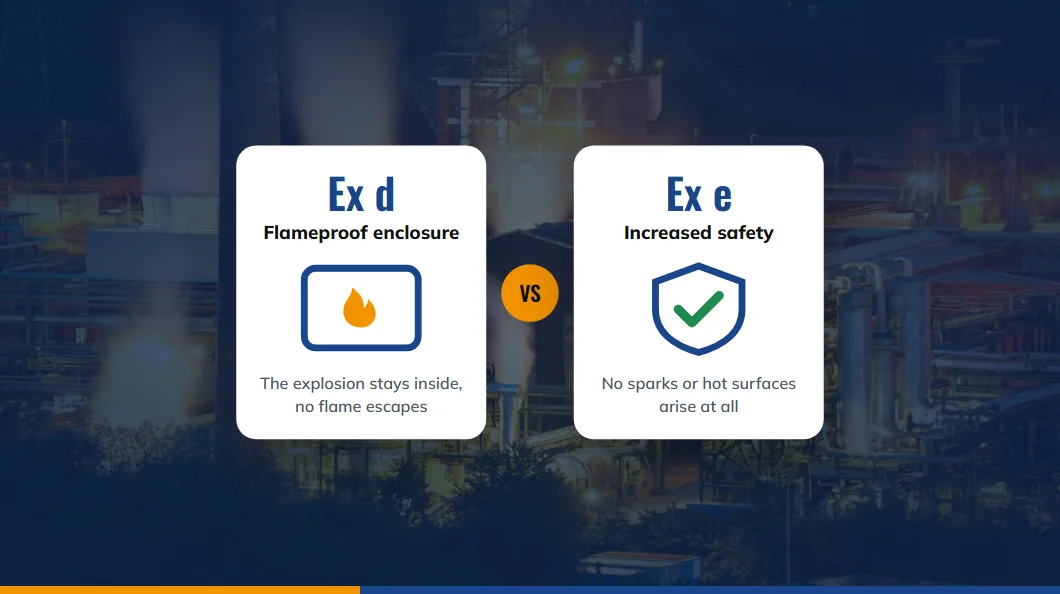
The basic idea of explosion protection is to prevent an ignition source and an explosive atmosphere from coming together. Ex d and Ex e achieve this in two almost opposite ways.
Flameproof enclosure (Ex d)
According to the definition in IEC 60079-1, Ex d is an enclosure in which the parts that could ignite an explosive gas atmosphere are placed. If a gas mixture that has entered the enclosure ignites, the enclosure withstands the resulting explosion pressure and prevents the explosion from passing to the surrounding atmosphere. In other words, an Ex d enclosure accepts that an explosion may occur inside; what matters is that the explosion does not spread outside the enclosure.
This is achieved by the flame paths (flameproof joints) where parts such as the cover and the body meet. The gap between these surfaces and the length of the path are limited in the standard. The permitted gaps vary by gas group (IIA, IIB, IIC). This is why the gas group on the label of Ex d equipment must suit the gas on site.
Increased safety (Ex e)
According to IEC 60079-7, Ex e is a type of protection in which additional measures are taken against the possibility of excessive temperatures and the occurrence of arcs and sparks. The aim here is not to withstand an explosion inside, but to prevent an ignition source from arising at all. To do this, creepage distances and clearances are increased, terminals and connections are designed to resist loosening, temperatures are limited and the enclosure is protected against dust and water. Ex e enclosures containing bare live parts must provide at least IP54.
Ex e is defined at two levels. Level "eb" is used for EPL Gb (or Mb in mining), and level "ec" for EPL Gc. Ex d similarly has the levels "da", "db" and "dc".
Advantages and limits
The biggest advantage of Ex d is that parts that produce arcs in normal operation, such as switches, contactors and drives, can also be placed inside. The price is weight and workmanship: the enclosure must be strong enough to withstand the explosion pressure, the flame paths must be precisely machined, and these surfaces must be protected every time the cover is opened.
Ex e generally offers a lighter enclosure that is easier to open, which is why it is common for terminal boxes and connection points. However, a part that produces arcs or sparks in normal operation cannot be placed in an Ex e enclosure. This limit led to the "Ex de" design, which combines the two types.
| Topic | Flameproof enclosure (Ex d) | Increased safety (Ex e) |
|---|---|---|
| Standard | IEC 60079-1 | IEC 60079-7 |
| Principle | Contains an internal explosion within the enclosure | Prevents arcs, sparks and excessive temperatures |
| Arcing parts | Can be placed inside | Cannot be placed inside |
| Protection levels | da, db, dc | eb, ec |
| Enclosure | Heavy, machined flame paths | Generally lighter, gasketed, IP rating critical |
| Cable entry | Ex d certified cable gland or blanking plug | Ex e or Ex d certified cable gland and blanking plug |
| Critical point in maintenance | Flame paths, cover bolts | Gasket, IP, terminal tightness |
Effect on cable entry and cable gland selection
The protection type directly determines the cable gland. According to the cable gland selection table in IEC 60079-14, only cable glands, adaptors and blanking plugs of the Ex d protection type may be fitted to Ex d equipment. On Ex e equipment, either Ex e or Ex d cable glands can be used. In short, an Ex d cable gland suits both enclosures, while an Ex e cable gland cannot be fitted to an Ex d enclosure.
With an Ex d enclosure there is one more step: the type of cable gland. The standard specifies a barrier (compound-filled) cable gland for Ex d entries or, under certain cable conditions, a seal-type Ex d cable gland. The 6th edition of IEC 60079-14, published in August 2024, introduced a flowchart for this selection. The flowchart includes criteria such as hydrogen or gas group IIC, the length of the connected cable and an enclosure volume exceeding 2000 cm³.
Other important rules:
- Unused entries are closed with a certified blanking plug that provides at least IP54 (or the higher value required by the location) and can only be removed with a tool.
- The installer may not drill additional holes in an Ex d enclosure afterwards.
- The 2014 edition of IEC 60079-1 limited threaded entries on Ex d enclosures to metric and NPT. The thread type and size (e.g. M25 or 1/2 NPT) are stated on the enclosure, on the label or in the installation instructions.
As an example, the BAT86 ex-proof LED floodlight has the Ex db and Ex tb protection types. Its IECEx certificate states as a specific condition of use that suitable certified cable glands or blanking plugs must be fitted to the two threaded entries on the enclosure, and that unused holes must be closed with a certified plug.
Ex de: a combination of the two types
Ex de is a combined design often found in control stations and distribution panels. Arcing components are housed in an Ex d compartment. Field cables enter an Ex e connection compartment containing increased safety terminals. The conductors between the two compartments pass through sealed bushings of the Ex d protection type. This method is called indirect entry.
The advantage for the user is clear: there is no need to open the heavy Ex d cover to connect cables, and field cables can be connected with Ex e cable glands. Even so, the rules of each compartment must be followed. Flame path rules apply to the Ex d compartment, and gasket and IP rules to the Ex e compartment.
Points to watch in maintenance
Inspection and maintenance are carried out in accordance with IEC 60079-17. Three grades of inspection are defined: visual, close and detailed; some defects, such as a loose terminal, can only be seen by opening the enclosure.
For Ex d enclosures:
- Flame path surfaces must not be painted. Only non-setting, solvent-free grease that does not corrode the surface may be used for protection against corrosion.
- All cover bolts must be in place and correctly tightened.
- Flame paths must not be repaired without the manufacturer's approval. For some products, such as BAT86, the certificate explicitly states that the flame paths cannot be repaired at all.
For Ex e enclosures:
- The gasket must be intact and the enclosure must maintain its IP rating.
- The tightness of terminals and conductor connections is checked during detailed inspection.
- No part that is not covered by the certificate may be added to the enclosure.
For both types, if the certificate number ends with the letter "X", the certificate contains specific conditions of use. These conditions must be read before installation.
The right product with Eksen Mühendislik
On our product pages you will find the “Ex işaretinin anlamı” (What the Ex marking means) section, which explains each product's Ex marking part by part, and the “Sahanıza uygun mu?” (Right for your site?) table, which shows zone suitability. For boxes with Ex d and Ex de enclosures, see the Control, Distribution and Junction Boxes and Control Stations pages, and for suitable cable glands the Ex-Proof Cable Glands page. Our article What is ex-proof? also helps with the general meaning of the Ex marking.
Sources
- IEC 60079-1:2014, Equipment protection by flameproof enclosures "d" (IEC Webstore)
- IEC 60079-7:2015+AMD1:2017, Equipment protection by increased safety "e" (IEC Webstore)
- IEC 60079-14:2024, Electrical installation design, selection and installation of equipment (IEC Webstore)
- Edition 6 of IEC 60079-14 is here, Dr. Martin Thedens (IECEx)
- Electrical Installations Design, Selection, Erection and Inspection, IECEx International Conference 2017
- Indirect entry in Ex d and Ex de enclosures (Cortem Group, manufacturer)
 Home
 Products
 Whatsapp
 Sidebar
 Top