


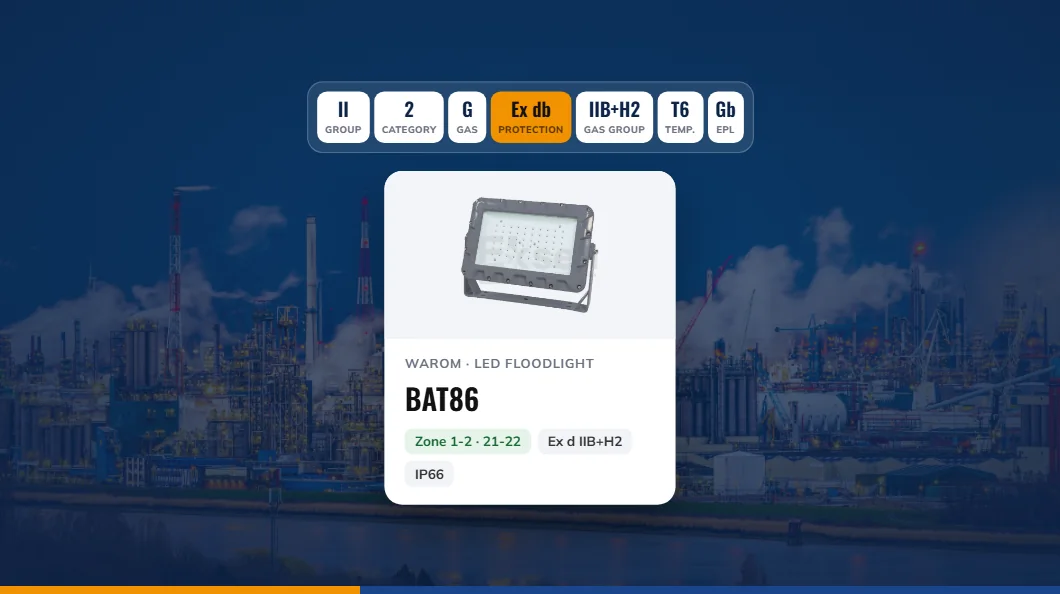
When selecting an ex-proof product, the most reliable information is the Ex marking on the product label and in its certificate. This short line tells you in which hazardous area, in which gas or dust and at which ambient temperature the product can be used safely. A buyer or plant engineer who cannot read the marking correctly may approve a product that is unsuitable for the site without noticing.
In this article we use the markings of the BAT86 ex-proof LED floodlight on our website as an example:
- For gas: II 2 G Ex db IIB+H2 T6…T4 Gb
- For dust: II 2 D Ex tb IIIC T80°C Db
The two layers of the marking
On an ex-proof product sold in Europe, the marking comes from two separate sources.
The first part (II 2 G) is the directive marking. Section 1.0.5 of Annex II to Directive 2014/34/EU requires, in addition to the name and address of the manufacturer, the CE marking, the series or type designation, the serial number and the year of construction, the hexagonal Ex symbol specific to explosion protection, followed by the symbol of the equipment group and category and, for group II, the letter G for gas atmospheres or D for dust atmospheres. In Turkey, the same requirement applies through the "Muhtemel Patlayıcı Ortamda Kullanılan Teçhizat ve Koruyucu Sistemler ile İlgili Yönetmelik (2014/34/AB)", the Turkish regulation implementing Directive 2014/34/EU, published in the Official Gazette (Resmî Gazete) No. 29758 of 30 June 2016.
The second part (Ex db IIB+H2 T6…T4 Gb) is the standard marking and comes from the IEC/EN 60079 series. This part is the same in ATEX and IECEx documents, because both systems are based on the same standards.
Reading the gas marking part by part
| Part | Meaning |
|---|---|
| II | Equipment group II: places other than mines where an explosive atmosphere hazard exists |
| 2 | Category 2: high level of protection, for places where an explosive atmosphere is likely to occur occasionally |
| G | Gas, vapour or mist atmosphere |
| Ex | Explosion-protected equipment |
| db | Flameproof enclosure (Ex d), protection level b |
| IIB+H2 | Gas group IIB, plus hydrogen |
| T6…T4 | Temperature class; between T6 and T4 depending on ambient temperature |
| Gb | Equipment protection level (EPL) Gb |
Equipment group and category: II 2 G
According to Annex I to Directive 2014/34/EU, group I covers the underground parts of mines and those surface parts of mining installations liable to be endangered by firedamp and/or combustible dust (categories M1 and M2). Group II covers all other places and is divided into three categories:
- Category 1: very high level of protection; places where an explosive atmosphere is present continuously, for long periods or frequently
- Category 2: high level of protection; places where an explosive atmosphere is likely to occur occasionally
- Category 3: normal level of protection; places where an explosive atmosphere is not expected to occur and, if it does, only infrequently and for a short period
Under Directive 1999/92/EC on the workplace side, category 2 equipment may be used in Zone 1 and Zone 2 (in dust, Zone 21 and Zone 22).
Protection type: db
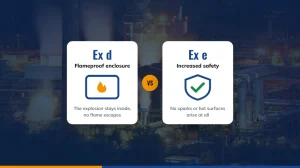
The letter "d" indicates a flameproof enclosure (Ex d): the enclosure is built to withstand an explosion that may occur inside it and to prevent the flame from passing to the outside. The a, b or c after the letter is the level of protection; a means very high, b high and c normal. Other common protection types are written with the letters e (increased safety), i (intrinsic safety), p (pressurised enclosure), m (encapsulation) and t (dust protection by enclosure).
Gas group: IIB+H2
Group II gases are divided into IIA, IIB and IIC according to how easily they ignite. The representative gases are propane for IIA, ethylene for IIB, and hydrogen and acetylene for IIC; IIC is the most easily ignited group. IIB+H2 means that the product is certified for IIB gases and, in addition, for hydrogen atmospheres.
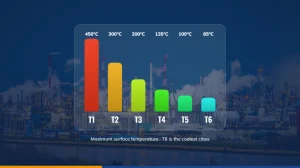
Temperature class: T6…T4
The temperature class sets the limit for the maximum surface temperature of the equipment: T1 450 °C, T2 300 °C, T3 200 °C, T4 135 °C, T5 100 °C, T6 85 °C. The temperature of the equipment's class must remain below the ignition temperature of the gas on site. The BAT86 is marked with a range because of the ambient temperature: according to its IECEx certificate, the product is T6 at ambient temperatures of −60…+40 °C, and T5 or T4, depending on enclosure and power, at ambient temperatures up to +60 °C.
Equipment protection level: Gb
The EPL tells you directly which zone the equipment is suitable for. Ga is for Zone 0, Gb for Zone 1 and Gc for Zone 2; in dust, Da, Db and Dc correspond to Zone 20, 21 and 22 respectively. ATEX categories 1G, 2G and 3G correspond, in the same order, to Ga, Gb and Gc.
Reading the dust marking: II 2 D Ex tb IIIC T80°C Db
- D: The product is certified for combustible dust atmospheres.
- tb: Dust protection by enclosure (Ex t), protection level b. Depending on the dust group and EPL, the enclosure is built to IP5X or IP6X dust tightness, and the external surface temperature is limited so that it does not exceed the value in the marking.
- IIIC: Dust group. IIIA is for combustible flyings, IIIB for non-conductive dust and IIIC for conductive dust; IIIC is the most demanding group.
- T80°C: For dust, the maximum surface temperature is stated directly in degrees instead of a temperature class. For the BAT86 this value is 80 °C at ambient temperatures up to +40 °C; according to the certificate, at +60 °C ambient it rises to 95 °C or 130 °C depending on enclosure and power. This is why the product page on our website shows the range T80°C…T130°C.
- Db: EPL for dust; suitable for Zone 21 and Zone 22.
The lower-case "db" and "Db" starting with a capital letter are different things: the first is the protection type and its level, the second is the equipment protection level.
The certificate number and the X at the end
The certificate number appears next to or below the marking. The IECEx certificate of the BAT86 is IECEx CQM 21.0015X: CQM identifies the issuing body, 21 the year and 0015 the sequence number. The X at the end of the number indicates that the certificate contains specific conditions of use. These conditions must be read before installation; the X is not a placeholder.
The difference between the ATEX marking and the IECEx marking
ATEX is European Union product legislation. The CE marking, the hexagonal Ex symbol and group and category information such as II 2 G are therefore markings required by the directive, and they are given together with the ATEX certificate number.
IECEx, by contrast, is an international certification system based on IEC standards. In an IECEx certificate, the Ex marking of the product is the standard marking (for example Ex db IIB+H2 T6…T4 Gb) and is given with the IECEx certificate number; the ATEX-specific category and the CE marking are not part of this system. If a product has both ATEX and IECEx certification, both certificate numbers may appear on the label. Because the standard marking is the same in both systems, selecting the zone by the EPL (Gb, Db) gives the same result with either document.
The “Ex işaretinin anlamı” (What the Ex marking means) tool on our product pages
On the product pages of our website, the “Ex işaretinin anlamı” (What the Ex marking means) section breaks down the product's gas and dust markings into their parts. When you click a part, for example IIB+H2, a short explanation of what it means opens. The “Sahanıza uygun mu?” (Right for your site?) table on the same page summarises the zones in which the product can be used.
The right product with Eksen Mühendislik
Once you have read the label, all you need to do is compare it with the zone, gas or dust group and temperature class of your site. As an example, see the BAT86 ex-proof LED floodlight; for other options, see the ex-proof lighting and control, distribution and junction boxes pages. For information on the certificate itself, read our article What is an ATEX certificate?, and for a product suited to your site, contact us.
Sources
- Directive 2014/34/EU, Annex I: Equipment groups and categories (legislation.gov.uk)
- Directive 2014/34/EU, Annex II, 1.0.5 Marking (legislation.gov.uk)
- Muhtemel Patlayıcı Ortamda Kullanılan Teçhizat ve Koruyucu Sistemler ile İlgili Yönetmelik (2014/34/AB), Official Gazette 30.06.2016, No. 29758 (in Turkish)
- Directive 1999/92/EC, Annex II: Selection of equipment categories (legislation.gov.uk)
- INERIS, poster on the ATEX and IECEx certification schemes
- BARTEC, Overview of Explosion Protection Techniques, IECEx 2018 International Conference (iecex.com)
 Home
 Products
 Whatsapp
 Sidebar
 Top