


In everyday language, "explosion-proof" is used as a general name for equipment designed to operate safely in areas where flammable gas or dust is present. Technically, however, this equipment is not protected by a single method but by different protection types defined in the IEC 60079 series of standards. To choose the right product, you need to know what these types do, how the site is classified and how the product is certified.
Basic concepts
An explosion requires three things at the same time: a flammable substance, oxygen (air) and an effective ignition source. Explosion protection works by removing one of these three. With electrical equipment we cannot always eliminate the gas or dust in the atmosphere, so we ensure that the equipment itself is not an ignition source.
- Explosive atmosphere: A mixture of flammable gas, vapour, mist or dust with air under atmospheric conditions, in which combustion spreads to the entire mixture after ignition.
- Hazardous area: An area in which such a mixture may be present. Areas are divided into Zone 0/1/2 (gas) and Zone 20/21/22 (dust) according to how often and for how long the mixture is present.
- Ignition source: Anything that can ignite an explosive atmosphere, such as hot surfaces, electrical sparks and arcs, mechanical sparks and electrostatic discharges.
Protection types and IEC 60079 standards
IEC 60079-0 sets out the general requirements for all Ex equipment; the detailed requirements for each protection type are in a separate part of the series. The table below lists the most common types:
| Protection type | Standard | Principle | Atmosphere |
|---|---|---|---|
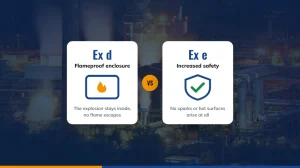
| Flameproof enclosure (Ex d) | IEC 60079-1 | Withstands an internal explosion; the flame is extinguished in the narrow flame paths at the joints and does not pass to the outside | Gas |
| Increased safety (Ex e) | IEC 60079-7 | Additional measures for equipment that does not spark in normal operation: insulation distances, robust enclosure, temperature limit | Gas |
| Intrinsic safety (Ex i) | IEC 60079-11 | The energy in the circuit is limited to a level that cannot ignite the atmosphere | Gas and dust |
| Pressurization (Ex p) | IEC 60079-2 | The enclosure is first purged, then internal overpressure keeps the explosive atmosphere out | Gas and dust |
| Encapsulation (Ex m) | IEC 60079-18 | The electrical circuit is embedded in a compound so the atmosphere cannot reach the source | Gas and dust |
| Dust ignition protection by enclosure (Ex t) | IEC 60079-31 | Dust-tight enclosure (IP5X or IP6X) and limited surface temperature | Dust |
| Powder filling (Ex q) | IEC 60079-5 | The potential ignition source is surrounded by a filling material such as quartz | Gas |
| Liquid immersion (Ex o) | IEC 60079-6 | Electrical parts are kept immersed in a liquid (oil) | Gas |
| Type of protection "n" (Ex n) | IEC 60079-15 | Equipment that is not an ignition source in normal operation only | Gas, Gc (Zone 2) only |
Protection levels: a, b, c
Many protection types are applied at three levels: "a" is very high, "b" high and "c" normal safety. For example, an intrinsically safe circuit marked "ia" can be used in Zone 0, whereas "ic" is for Zone 2 only. In the same way, "db" and "eb" are suitable for Zone 1, and "dc" and "ec" for Zone 2. The level letter is written on the product label directly after the protection type (e.g. Ex db, Ex eb, Ex tb).
Several types combined
A product may combine more than one protection type. For example, the lamp or switch compartment may be protected by a flameproof enclosure (Ex d) and the cable connection compartment by increased safety (Ex e). On the label this appears as "Ex db eb".
Hazardous area classification
The starting point for equipment selection is area classification. IEC 60079-10-1 provides guidance for gas atmospheres and IEC 60079-10-2 for dust atmospheres. In Türkiye, the "Regulation on the Protection of Workers from the Risks of Explosive Atmospheres" (the Turkish counterpart of Directive 1999/92/EC) defines the zones as follows:
| Zone | Definition | Typical example |
|---|---|---|
| Zone 0 | An explosive atmosphere of gas, vapour or mist is present continuously, for long periods or frequently | Inside tanks and vessels containing flammable substances |
| Zone 1 | Likely to occur occasionally in normal operation | The immediate surroundings of Zone 0, pump and valve seals, filling openings |
| Zone 2 | Not likely in normal operation; if it occurs, it lasts only a short time | The surroundings of Zone 0 or Zone 1 |
| Zone 20 | A cloud of combustible dust is present continuously, for long periods or frequently | Inside mills, dryers, mixers and silos |
| Zone 21 | Likely to occur occasionally in normal operation | The immediate surroundings of dust filling and emptying points |
| Zone 22 | Not likely in normal operation; if it occurs, it lasts only a short time | Areas where dust may leak and accumulate |
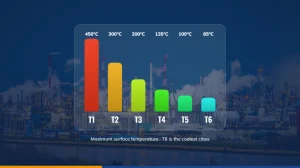
The employer carries out the classification and records the results in the explosion protection document. Under the regulation, category 1 equipment is used in Zones 0 and 20, category 1 or 2 in Zones 1 and 21, and category 1, 2 or 3 in Zones 2 and 22. In addition to the zone, the gas group (IIA, IIB, IIC), the dust group (IIIA, IIIB, IIIC) and the temperature class (T1–T6) also determine the selection. For a detailed table, see our article What is ex-proof?.
Types of explosion-protected equipment
Enclosures and boxes
Junction boxes, distribution boxes and control stations are the nodes of the electrical installation in a hazardous area. For Ex d boxes, the strength of the enclosure, the protection of the joints (flame paths) and the heat dissipation of the devices inside are critical. For Ex e boxes, there are no unprotected sparking parts inside; terminals, insulation distances and the ingress protection rating of the enclosure are the key points.
Luminaires
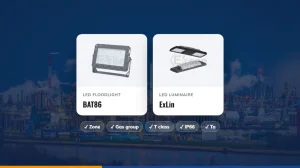
The most important selection criteria for ex-proof luminaires are the protection type, the gas and dust group and the temperature class. The maximum surface temperature of the luminaire must remain below the ignition temperature of the gas or dust present.
Control stations, plugs and sockets
Control stations containing push buttons, switches and indicator lamps, as well as plug and socket units, produce sparks in normal operation because their contacts open and close. Since increased safety (Ex e) does not allow unprotected sparking parts, the section containing the contacts is protected by a type of protection that separates the spark from the outside atmosphere, such as a flameproof enclosure (Ex d).
Cable entries and cable glands
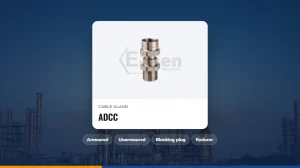
In Ex d enclosures, cable entry devices are one of the critical parts of the protection. Entry devices such as cable glands, blanking plugs and reducers must be certified and suitable for the protection type, gas group and protection level of the enclosure; otherwise the certified protection of the enclosure cannot be maintained.
Certification: ATEX and IECEx
In the European Union, equipment for explosive atmospheres must comply with Directive 2014/34/EU (ATEX). The directive has applied since 20 April 2016 and replaced the former Directive 94/9/EC. Its Turkish counterpart is the "Regulation on Equipment and Protective Systems Intended for Use in Potentially Explosive Atmospheres (2014/34/EU)", published in Official Gazette No. 29758 of 30 June 2016. On the workplace side, the Turkish counterpart of Directive 1999/92/EC is the "Regulation on the Protection of Workers from the Risks of Explosive Atmospheres" (30 April 2013, No. 28633).
The European Commission stresses that certificates of conformity may be issued only by notified bodies and only within the scope for which they are notified, and that voluntary additional certificates do not count as proof of conformity. IECEx, on the other hand, is an international certification system based on IEC standards and is accepted in many countries. A single product may carry more than one certificate for different markets. For details, see our article What is an ATEX certificate?.
Retrofit or new installation?
Improving explosion protection in an existing plant and building a new plant raise different questions. In both cases, the roadmap is set by the standards:
- Update the area classification. If the process, materials or layout have changed, the classification and the explosion protection document must also be updated; the regulation requires the document to be revised when significant changes are made to the workplace, work equipment or organisation of work.
- Design the installation to IEC 60079-14. This part covers the design, equipment selection and erection of electrical installations.
- Plan inspection and maintenance to IEC 60079-17. If old equipment is to remain in place, its condition must be inspected according to this part.
- Have repairs carried out to IEC 60079-19. The repair and overhaul of Ex equipment are subject to separate rules; an unsuitable repair can invalidate the certified protection.
A retrofit usually requires less downtime, but you must always check whether the certificate and condition of the old equipment still match the current classification. In a new installation, equipment can be selected to current editions of the standards from the outset.
The right product with Eksen Mühendislik
If the zone, gas or dust group and temperature class of your site are known, finding the right product becomes easier. In our control, distribution and junction boxes, control stations, ex-proof lighting and ex-proof cable glands categories, the Ex marking and the suitable zones are shown separately for each product. For project-specific questions, contact us.
Sources
- IECEx, Standards (parts of the IEC 60079 series)
- IEC 60079-0:2026, Explosive atmospheres – Part 0: Equipment – General requirements
- IECEx International Conference 2018, Overview of Explosion Protection Techniques (BARTEC)
- HSE, ATEX technical standards
- European Commission, Equipment for potentially explosive atmospheres (ATEX)
- Regulation on Equipment and Protective Systems Intended for Use in Potentially Explosive Atmospheres (2014/34/EU), Official Gazette 30.06.2016, No. 29758 (in Turkish)
- Regulation on the Protection of Workers from the Risks of Explosive Atmospheres, Official Gazette 30.04.2013, No. 28633 (in Turkish)
- U.S. Chemical Safety Board (CSB), Combustible Dust Hazard Study (2006)
- Turkish Ministry of Labour and Social Security (ÇSGB), Application Guide on the Protection of Workers from the Risks of Explosive Atmospheres (in Turkish)
 Home
 Products
 Whatsapp
 Sidebar
 Top