


Fire and explosion are among the most serious risks for the designers, installers and operators of any plant that handles flammable substances. This risk is not limited to chemical and petrochemical plants; explosive atmospheres can also form in seemingly ordinary facilities that generate flour, sugar, wood or metal dust. To manage the risks properly, you first need to understand how an explosion occurs.
Combustion, flash fire and explosion
Combustion is the reaction of a flammable substance with oxygen that releases heat. A fire requires three elements: fuel (a flammable substance), oxygen (air) and an ignition source. If one side of this "fire triangle" is removed, a fire cannot occur.
If the flammable substance is mixed with air as a gas, vapour or fine dust, combustion proceeds very rapidly and creates a pressure wave; this is called an explosion. Explosions are divided into two types according to how the flame propagates:
- Deflagration: The most common type. The pressure wave travels at less than the speed of sound relative to the unburned mixture.
- Detonation: The most destructive type of explosion, in which the pressure wave travels faster than the speed of sound. Flame speed and overpressure are much higher than in a deflagration.
Under certain conditions a deflagration can turn into a detonation. In pipelines in particular, turbulence created by obstacles such as valves, bends and tees accelerates the flame. Highly reactive mixtures such as hydrogen-air and acetylene-air are more prone to this transition.
Under what conditions does an explosion occur?
According to the application guide of the Turkish Ministry of Labour and Social Security, four conditions must be present at the same time for a hazardous explosion:
- The flammable substance must be present in a highly dispersed form (as gas, vapour, mist or suspended dust).
- The concentration of the flammable substance in air must be between the lower and upper explosive limits.
- A hazardous quantity of explosive atmosphere must form.
- An effective ignition source must be present.
Lower and upper explosive limits
Every flammable gas or vapour has a lower explosive limit (LEL) and an upper explosive limit (UEL). If the concentration is below the LEL, the mixture is too "lean" to ignite; above the UEL it is too "rich"; an explosion occurs only between these two limits. These values apply to atmospheric conditions. As the guide points out, as temperature and pressure rise, the lower limit falls and the upper limit rises; in other words, the explosive range widens. When the oxygen content and temperature increase, the minimum energy required for ignition can also decrease considerably.
For flammable liquids, the criterion is the flash point. If the surface temperature of the liquid is kept permanently and sufficiently below the flash point (according to the guide, by 5 °C for pure solvents and 15 °C for solvent mixtures), the vapour concentration at the surface is considered to remain below the lower limit.
Hybrid mixtures
A gas and a dust that are each below their lower explosive limit can, when present together, form a hybrid mixture and cause very powerful explosions. In such atmospheres gas detectors may also give misleading readings, so hybrid mixtures must be assessed separately.
Dust explosions
The guide defines combustible dust as solid particles of 500 µm or smaller that can remain suspended in air and form an explosive mixture with air. For a dust explosion, two more elements are added to the fire triangle: dispersion of the dust in air and confinement. The U.S. Chemical Safety Board (CSB) describes these five elements as the "dust explosion pentagon"; if either dispersion or confinement is removed, an explosion is prevented, although a fire may still occur.
The most dangerous aspect of dust explosions is secondary explosions. A weak primary explosion lifts and ignites dust that has accumulated on floors, beams or above suspended ceilings. The resulting secondary explosion can be much more powerful than the first and can trigger a chain of further explosions. According to the ministry guide, a dust layer of 1 mm or less covering the floor of a room of average height is enough to form an explosive atmosphere when it is dispersed.
The CSB's 2006 study found that 281 combustible dust incidents in the US between 1980 and 2005 killed 119 workers and injured 718 people. The same study notes that fewer than half of the safety data sheets examined contained a warning about the explosion hazard of the dust.
Ignition sources
If the formation of an explosive atmosphere cannot always be prevented, the next step is to eliminate ignition sources. Explosion protection standards consider 13 types of ignition source:
| Ignition source | Examples |
|---|---|
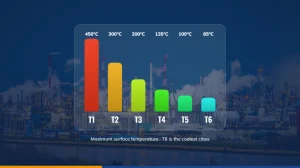
| Hot surfaces | Heaters, dryers, poorly lubricated bearings and shafts, mechanical brakes |
| Flames and hot gases | Open fire, welding, smoking, hot combustion gases |
| Mechanical sparks | Friction, impact, grinding and cutting |
| Electrical equipment | Opening and closing of contacts, loose connections, short circuits |
| Stray currents and cathodic protection | Return currents, magnetic induction, earthing faults |
| Static electricity | Unearthed conductive parts, pneumatic conveying, silo filling |
| Lightning | Atmospheric discharges |
| Radio-frequency electromagnetic waves (up to 300 GHz) | Radio transmitters, industrial high-frequency generators |
| Electromagnetic waves above 300 GHz | Lasers and intense optical radiation |
| Ionising radiation | X-ray equipment, radioactive sources |
| Ultrasound | Conversion of sound energy absorbed in a solid or liquid into heat |
| Adiabatic compression and shock waves | Sudden opening of valves, shock waves |
| Exothermic reactions | Chemical reactions that release heat, self-ignition of dusts |
An important note for electrical installations: the ministry guide emphasises that electrical sparks and hot surfaces of electrical equipment can be ignition sources even at low voltages. Using a low voltage is not an explosion protection measure in itself; the equipment must be certified for explosive atmospheres.
How can explosion risk be reduced?
Legislation and guidance set out protection in a specific order:
- Prevent the formation of an explosive atmosphere. Replace the flammable substance with a less hazardous one, keep the concentration outside the explosive limits, provide adequate ventilation and remove dust deposits regularly.
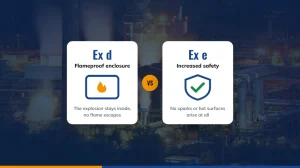
- Prevent ignition sources. Classify the hazardous areas (Zone 0/1/2 and Zone 20/21/22); in these areas use only certified ex-proof equipment suitable for the zone, earth conductive parts and control hot work through a permit system.
- Limit the effects of an explosion. Use protective systems such as explosion-pressure-resistant design, explosion venting, explosion suppression systems and isolation that prevents flame propagation.
In Türkiye, these steps are documented in the explosion protection document required by the "Regulation on the Protection of Workers from the Risks of Explosive Atmospheres" (the Turkish counterpart of Directive 1999/92/EC). The equipment itself must comply with the "Regulation on Equipment and Protective Systems Intended for Use in Potentially Explosive Atmospheres (2014/34/EU)", which transposes Directive 2014/34/EU. For the basic principles of ex-proof equipment, see our article What is ex-proof?, and for ignition energy, What is minimum ignition energy (MIE)?.
The right product with Eksen Mühendislik
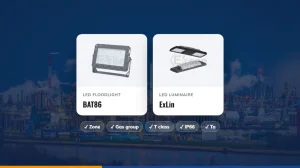
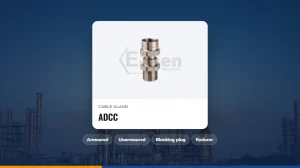
The way to reduce the ignition risk from the electrical installation in a hazardous area is to select every component to suit the zone. In our ex-proof lighting, plugs, sockets and combination panels and control, distribution and junction boxes categories, the zones in which each product can be used are shown separately. To determine the right product for your site together, contact us.
Sources
- Turkish Ministry of Labour and Social Security (ÇSGB), Application Guide on the Protection of Workers from the Risks of Explosive Atmospheres (2015, revised 2024) (in Turkish)
- U.S. Chemical Safety Board (CSB), Combustible Dust Hazard Study (2006)
- Gexcon, Detonation, deflagration and DDT
- IECEx International Conference 2018, Overview of Explosion Protection Techniques (BARTEC)
- Regulation on the Protection of Workers from the Risks of Explosive Atmospheres, Official Gazette 30.04.2013, No. 28633 (in Turkish)
 Home
 Products
 Whatsapp
 Sidebar
 Top