


Will an electrostatic discharge, the arc of a switch as it opens or a spark from a metal part striking another be enough to ignite an explosive atmosphere? The answer depends largely on the minimum ignition energy (MIE) of the substance present. Substances with a low MIE can be ignited even by sparks that are barely visible, which makes MIE a basic input for the selection of ex-proof equipment and for the management of hazardous areas.
What is MIE?
Minimum ignition energy is the smallest electric spark energy that can ignite a mixture of a flammable substance and air. It is expressed in units of energy, usually millijoules (mJ); it is not a value per gram or per cubic metre.
MIE is not a fixed property of a substance; it depends on the test conditions:
- Mixture ratio: The lowest value is measured at the fuel-air ratio most favourable for ignition. As the mixture approaches the lower or upper explosive limit, the energy required rises very quickly.
- Temperature: MIE falls as temperature rises; according to U.S. Bureau of Mines data, an increase of 100 °C roughly halves the value.
- Pressure: MIE varies approximately in inverse proportion to the square of the pressure; the higher the pressure, the easier the ignition.
- Oxygen content: In pure oxygen, MIE is much lower than in air. For methane, for example, the value drops from 0.30 mJ in air to 0.003 mJ in oxygen.
For this reason, the values in tables are comparative values valid for the stated standard conditions (usually 25 °C and 1 atm); the actual risk on site must be assessed against the process conditions.
How is MIE measured?
MIE is measured in the laboratory with a controlled spark. For gases and vapours, the mixture is placed in a test vessel; for dusts, the dust is dispersed with air inside the vessel to form a cloud. The spark is usually produced by discharging a charged capacitor between two electrodes, and the stored energy is calculated with the relation E = ½ × C × V² (C is capacitance, V is voltage). The energy, mixture ratio and electrode gap are varied to find the lowest value at which ignition occurs.
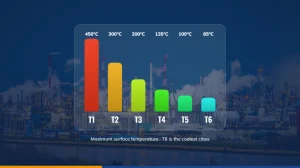
Spark ignition and hot-surface ignition are separate concepts. The lowest temperature at which a heated surface or vessel ignites the mixture is not the MIE but the auto-ignition temperature. The temperature class of equipment (T1–T6) relates to this second quantity: for example, the surface of a T4 luminaire must not exceed 135 °C.
MIE values of gases and vapours
Most flammable gases and vapours have an MIE in air between 0.1 and 0.3 mJ. Substances such as acetylene, hydrogen and carbon disulphide are far below this. The values below are taken from U.S. Bureau of Mines Bulletin 680 (Kuchta, 1985) and are measurements in air at 25 °C and 1 atm, at or near the mixture ratio most favourable for ignition. The gas group column shows the group for which the substance is listed as a representative gas in the IEC/EN 60079 classification.
| Substance | MIE in air (mJ) | Gas group |
|---|---|---|
| Carbon disulphide | 0.015 | IIC |
| Hydrogen | 0.017 | IIC |
| Acetylene | 0.017 | IIC |
| Ethylene | 0.07 | IIB |
| Hydrogen sulphide | 0.077 | |
| Methanol | 0.14 | |
| Benzene | 0.22 | |
| Propane | 0.26 | IIA |
| Methane | 0.30 | |
| Acetaldehyde | 0.38 | IIA |
| Acetone | 1.15 | IIA |
The table also shows the logic behind gas groups: the IEC system divides gases into subgroups on the basis of minimum ignition current and energy and the maximum experimental safe gap (MESG). The MIE of hydrogen and acetylene in group IIC is about one fifteenth of that of propane in group IIA; this is why IIC is the most easily ignited gas group and therefore the one that places the highest demands on equipment.
MIE values in the literature can differ slightly depending on the test apparatus and conditions; any value used for design should always be taken together with its source and test conditions.
MIE of dust clouds
The MIE values of combustible dust clouds are generally one or more orders of magnitude (10 times or more) higher than those of gases, and the measurement uncertainty is greater. For dust, the most decisive factor is particle size: the finer the particles, the larger the surface area per unit mass and the lower the MIE. According to U.S. Bureau of Mines data, for metal dusts finer than 74 µm the MIE is as low as a few millijoules for the most reactive metals and as high as a few joules for the least reactive; dusts of intermediate reactivity are mostly at 100 mJ and above.
The higher MIE of dust compared with gases does not make it safe. Operations such as conveying, sieving and grinding make the dust finer and can make ignition easier, while dust that settles on floors, on top of machinery and on elevated horizontal surfaces becomes fuel that feeds an explosion once it is raised into the air. The U.S. Chemical Safety Board (CSB) found that the explosion at the Imperial Sugar refinery in Georgia on 7 February 2008, which killed 14 people and injured 38, was fuelled by large quantities of sugar dust that had accumulated throughout the packaging building, and recommended in particular that dust accumulation on elevated surfaces be prevented. This is why Directive 1999/92/EC and the corresponding Turkish workplace regulation treat layers and deposits of dust as sources that can form an explosive atmosphere, and why dust environments are classified separately as Zone 20, 21 and 22.
Why does MIE matter on site?
The energy of everyday sources is much higher than the MIE of many substances. According to an example given by the U.S. Bureau of Mines, a human body with a capacitance of about 300 pF charged to 10,000 V can produce an electrostatic discharge of about 15 mJ; this exceeds the MIE of every gas in the table. The switching sparks of ordinary electrical equipment can carry energies in the order of joules.
Ex-proof equipment manages this risk in different ways:
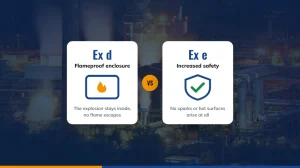
- Flameproof enclosure (Ex d): A spark may occur, but an explosion that starts inside is not transmitted outside the enclosure.
- Increased safety (Ex e): For parts that do not produce sparks or arcs in normal operation, additional measures reduce the likelihood of sparks and overheating.
- Intrinsic safety (Ex i): Energy, voltage and current in the circuit are limited so that they stay below the energy needed for ignition. This protection type is based directly on the MIE principle.
Equipment selection alone is not enough: the minimum requirements of Directive 1999/92/EC also require the employer to take measures against ignition risks from electrostatic discharges, including the provision of suitable working clothes.
The right product with Eksen Mühendislik
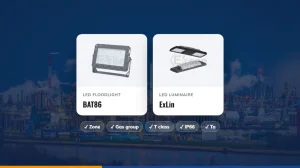
If the group and temperature class of the gas or dust on your site are known, it is enough to check that the IIA/IIB/IIC or IIIA/IIIB/IIIC group and the T class on the product label cover them. On our product pages you can review ex-proof lighting and control, distribution and junction boxes suitable for areas with IIC gases such as hydrogen; for example, the BAT86 ex-proof LED floodlight is marked IIB+H2. We explain each part of the label in our article What is an ATEX certificate?.
Sources
- U.S. Bureau of Mines, Bulletin 680: Investigation of Fire and Explosion Accidents in the Chemical, Mining, and Fuel-Related Industries (Kuchta, 1985), Table 13
- IECEx 2018 International Conference, BARTEC: Overview of Explosion Protection Techniques (gas groups, temperature classes, Ex i)
- U.S. Chemical Safety Board (CSB): Imperial Sugar Company Dust Explosion and Fire
- Directive 1999/92/EC (EU text on legislation.gov.uk): Annex I and Annex II
 Home
 Products
 Whatsapp
 Sidebar
 Top