


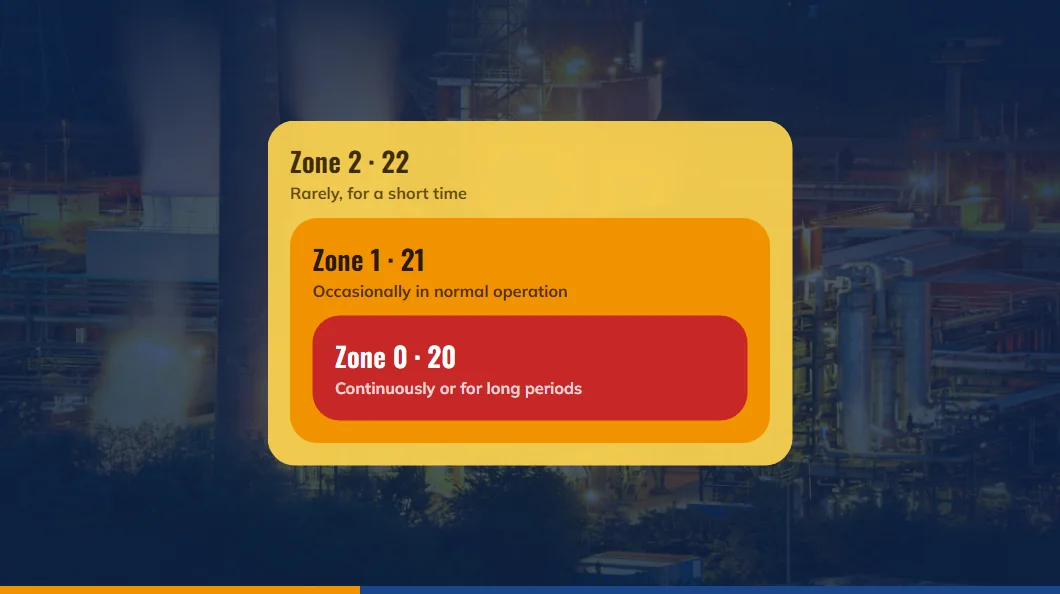
The first step in selecting ex-proof equipment is knowing which hazardous area the equipment will be installed in. Zone classification answers this question: how often does an explosive atmosphere form there, and how long does it persist? Without a known zone, it is not possible to select the right ATEX category, the right equipment protection level (EPL) and therefore the right product.
What determines the zone?
Classification is based on how frequently an explosive atmosphere occurs and how long it lasts. There are three zones for gas, vapour and mist (Zone 0, 1, 2) and three zones for combustible dust (Zone 20, 21, 22).
The definitions are set out in Annex I to Directive 1999/92/EC on the workplace side. In Turkey, the same definitions are found in Annex 1 of the "Çalışanların Patlayıcı Ortamların Tehlikelerinden Korunması Hakkında Yönetmelik", the Turkish regulation prepared in parallel with this directive and published in the Official Gazette (Resmî Gazete) No. 28633 of 30 April 2013. According to the directive, "normal operation" in these definitions means the situation when installations are used within their design parameters.
International standards describe how classification is carried out:
- IEC 60079-10-1: Classification of areas for explosive gas atmospheres (current edition: 3.0, 2020)
- IEC 60079-10-2: Classification of areas for explosive dust atmospheres (current edition: 3.0, 2026). The standard deals with dust clouds and combustible dust layers separately.
Gas zones: Zone 0, 1 and 2
- Zone 0: Places where an explosive atmosphere consisting of a mixture of air with gas, vapour or mist is present continuously, for long periods or frequently. According to the implementation guide of the Turkish Ministry of Labour and Social Security, these conditions generally occur inside closed systems handling flammable substances, for example inside containers, closed vessels and evaporators.
- Zone 1: Places where an explosive atmosphere is likely to occur occasionally in normal operation. Examples in the guide: the immediate vicinity of Zone 0 areas, the surroundings of feed openings, and the surroundings of pump and valve seals that do not seal well.
- Zone 2: Places where an explosive atmosphere is not likely to occur in normal operation but, if it does occur, persists for a short period only. These are generally the immediate surroundings of Zone 0 or Zone 1.
The legislation does not set hour limits for the zones. The UK Health and Safety Executive (HSE), noting that there is no officially adopted limit, gives the most commonly used values as follows: more than 1000 hours per year of explosive atmosphere for Zone 0, between 10 and 1000 hours for Zone 1, and less than 10 hours for Zone 2.
Dust zones: Zone 20, 21 and 22
- Zone 20: Places where an explosive atmosphere in the form of a cloud of combustible dust in air is present continuously, for long periods or frequently. According to the guide, this is generally the inside of containers and pipework; these conditions may occur in mills, dryers, mixers, extractors and silos.
- Zone 21: Places where a dust cloud is likely to form an explosive atmosphere occasionally in normal operation; for example, the immediate vicinity of filling and emptying points.
- Zone 22: Places where a dust cloud is not likely to form an explosive atmosphere in normal operation but, if it does, persists for a short period only; for example, areas where dust leaks and accumulates.
In dust, layers matter as well. According to the directive, layers, deposits and heaps of combustible dust must be considered like any other source that can form an explosive atmosphere. In its examples, IEC 60079-10-2 also assumes that effective housekeeping prevents dust layers from building up; if housekeeping is inadequate, the possibility of dust clouds forming from layers must be added to the classification.
Matching zones to ATEX categories and EPLs
Under Annex II to Directive 1999/92/EC and Annex 3 of the Turkish regulation, unless the explosion protection document states otherwise, equipment is selected according to the categories below. The EPL equivalents in the table come from IEC 60079-0.
| Zone | Atmosphere | Explosive atmosphere | Suitable ATEX category | EPL |
|---|---|---|---|---|
| Zone 0 | Gas | Continuous, long periods or frequent | 1G | Ga |
| Zone 1 | Gas | Occasional in normal operation | 1G or 2G | Ga or Gb |
| Zone 2 | Gas | Not likely, short period if it occurs | 1G, 2G or 3G | Ga, Gb or Gc |
| Zone 20 | Dust | Continuous, long periods or frequent | 1D | Da |
| Zone 21 | Dust | Occasional in normal operation | 1D or 2D | Da or Db |
| Zone 22 | Dust | Not likely, short period if it occurs | 1D, 2D or 3D | Da, Db or Dc |
The table reads as follows: equipment with a higher level of protection may be used in a lower-risk zone, but not the other way round. The category alone is not enough; the equipment must also suit the gas or dust group and the temperature class on site.
Who carries out the classification?
The responsibility lies with the employer. Under Article 9 of the Turkish regulation, the employer classifies places where explosive atmospheres may occur in accordance with Annex 1, applies the minimum requirements of Annexes 2 and 3 in these places, and places the warning signs of Annex 4 at the entrances to hazardous areas.
The result of the classification is recorded in the explosion protection document. Under Article 10 of the regulation, this document is prepared before work begins, revised when significant changes are made, and contains the following:
- Identification and assessment of explosion risks
- The measures to be taken
- The places classified according to Annex 1
- The places where the minimum requirements will apply
- A statement that the design, use and maintenance of equipment comply with safety rules
- A statement that the equipment complies with the Turkish regulation on health and safety requirements for the use of work equipment (İş Ekipmanlarının Kullanımında Sağlık ve Güvenlik Şartları Yönetmeliği)
According to the directive, equipment may be put into service only if the explosion protection document shows that it can be used safely in an explosive atmosphere. An equipment supplier cannot determine the zone on your behalf; to recommend the right product, it needs to know the result of the classification.
The “Sahanıza uygun mu?” (Right for your site?) table on our product pages
On the product pages of our website, the “Sahanıza uygun mu?” (Right for your site?) table shows at a glance the zones in which the product can be used for gas and dust. For example, the BAT86 ex-proof LED floodlight is shown as suitable for Zone 1, 2, 21 and 22 and not suitable for Zone 0 and Zone 20, because its marking is II 2 G and II 2 D and its EPL is Gb and Db. The same section also shows the product's ambient temperature range and temperature class. Each part of the product's Ex marking is explained in the “Ex işaretinin anlamı” (What the Ex marking means) section directly below it.
The right product with Eksen Mühendislik
With the zone, gas or dust group and temperature class from your explosion protection document, product selection is faster. On the ex-proof lighting, ex-proof cable glands and control stations pages you can see the zones each product is suitable for. For obligations on the workplace side, see our article How the ATEX directives affect your business, and for your site, contact us.
Sources
- Çalışanların Patlayıcı Ortamların Tehlikelerinden Korunması Hakkında Yönetmelik, Official Gazette 30.04.2013, No. 28633 (in Turkish)
- Directive 1999/92/EC, Annex I: Classification of places where explosive atmospheres may occur (legislation.gov.uk)
- Directive 1999/92/EC, Annex II: Minimum requirements and selection of equipment (legislation.gov.uk)
- Ministry of Labour and Social Security of Turkey, Implementation Guide on the Protection of Workers from the Hazards of Explosive Atmospheres (in Turkish)
- IEC 60079-10-1:2020, Classification of areas, Explosive gas atmospheres (IEC Webstore)
- IEC 60079-10-2:2026, Classification of areas, Explosive dust atmospheres (IEC Webstore)
- HSE, Hazardous Area Classification and Control of Ignition Sources
- INERIS, poster on the ATEX and IECEx certification schemes
 Home
 Products
 Whatsapp
 Sidebar
 Top