


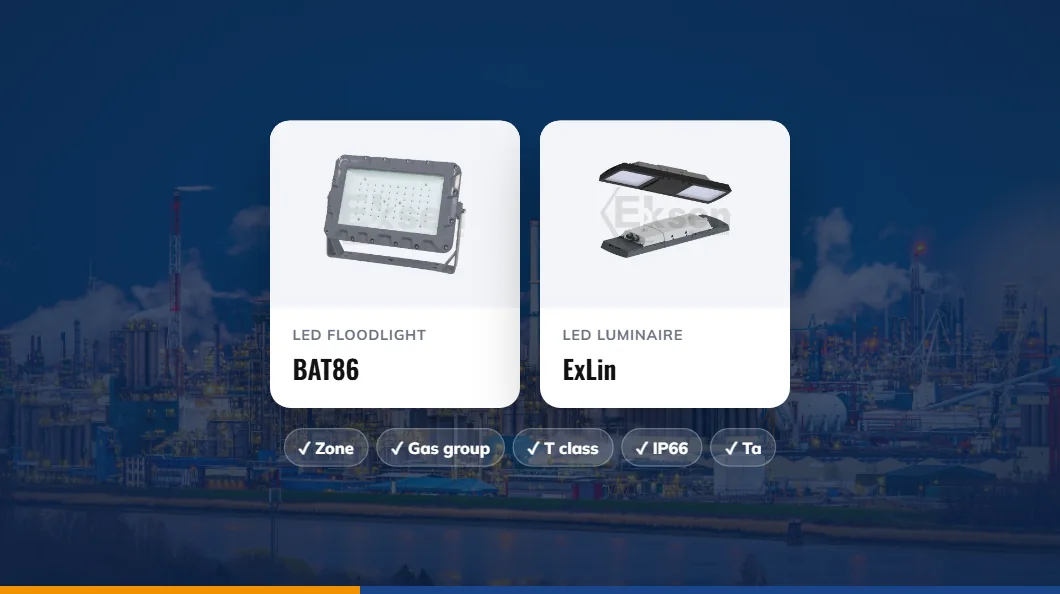
Lighting in a hazardous area is critical equipment for both occupational safety and explosion protection. LED luminaires are replacing older lamps thanks to their low energy consumption and long service life, but when choosing an ex-proof luminaire the first thing to look at is not the power but the classification of the site. We explain the checkpoints below using the BAT86 ex-proof LED floodlight as an example.
1. Zone and equipment category
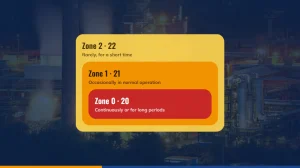
First, you need to know which hazardous zone the luminaire will be installed in. This classification is given in the explosion protection document prepared by the employer. The Turkish "Regulation on the Protection of Workers from the Hazards of Explosive Atmospheres" (Official Gazette, 30 April 2013, issue 28633), which transposes the EU workplace directive 1999/92/EC, specifies the equipment category that may be used in each zone as follows:
| Zone | Atmosphere | Permitted category |
|---|---|---|
| Zone 0 / Zone 20 | Explosive atmosphere present continuously, for long periods or frequently | Category 1 |
| Zone 1 / Zone 21 | Occasionally in normal operation | Category 1 or 2 |
| Zone 2 / Zone 22 | Not expected in normal operation; if it occurs, only for a short period | Category 1, 2 or 3 |
The ATEX marking of the BAT86 includes "II 2G" and "II 2D": category 2 for gas and dust. It can therefore be used in Zones 1, 2, 21 and 22, but not in Zone 0 or Zone 20. The “Sahanıza uygun mu?” (Right for your site?) table on the product pages shows this match for each product.
2. Gas group and dust group
Gas groups are ranked IIA, IIB and IIC. According to IEC 60079-0, equipment marked IIB can also be used where IIA is required, and equipment marked IIC where IIA and IIB are required; the reverse does not apply. The group of the gas on site is taken from gas and vapour data or from the hazardous area classification report.
The 90 and 240 enclosures of the BAT86 are certified "IIB+H2": in addition to IIB gases, they can also be used in hydrogen atmospheres. The 160 enclosure is certified IIB. Because the gas group can vary by enclosure within the same product family, selection must be made down to the model code. In dusty atmospheres, the dust group in the marking (IIIA, IIIB, IIIC) must also cover the dust on site; the BAT86 is marked IIIC.
3. Temperature class and ambient temperature (Tamb)
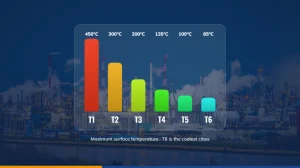
The temperature class shows the highest temperature that any surface of the luminaire can reach. This value must be lower than the ignition temperature of the gas on site.
| Temperature class | Maximum surface temperature |
|---|---|
| T1 | 450 °C |
| T2 | 300 °C |
| T3 | 200 °C |
| T4 | 135 °C |
| T5 | 100 °C |
| T6 | 85 °C |
In dust atmospheres, a temperature is stated directly instead of a class (e.g. T80°C). As HSE points out, the temperature that ignites a dust layer depends on the layer's thickness and contact time; dust build-up on the luminaire should therefore be monitored during maintenance.
The temperature class is not independent of the ambient temperature. According to IEC 60079-0, unless marked otherwise, equipment is designed for an ambient temperature of -20 °C to +40 °C; a different range is stated in the marking and in the certificate. The BAT86's IECEx certificate illustrates this well: between -60 °C and +40 °C, all models are T6 (T80°C for dust), whereas with an upper ambient limit of +60 °C, T5 (T95°C) or T4 (T130°C) applies depending on the model. In a hot process area, the luminaire's class must therefore be read for the high ambient temperature.
4. IP rating
The IP rating (IEC 60529) indicates protection against dust and water and is separate from Ex protection. The required rating is determined by the dust, rain, washdown and condensation conditions of the environment. According to its certificate, the BAT86 provides IP66 in accordance with IEC 60529. The cable gland and blanking plug at the cable entry must also maintain this rating.
5. Enclosure and diffuser material
The enclosure material is assessed for corrosion, impact and weight. The BAT86 has a copper-free die-cast aluminium enclosure and a glass diffuser. Certificates may contain specific conditions of use related to the material. The BAT86 certificate stipulates that, because of the risk of electrostatic charging, the luminaire must not be used in locations affected by charge-generating processes (e.g. near electrostatic painting equipment) or by pneumatic dust conveying.
6. Luminous flux and efficacy
Compare luminaires by lumens (lm) and lumens per watt, not by watts. Two luminaires of the same power can deliver very different amounts of light. The BAT86 family covers 60 W to 240 W and, depending on the model, a luminous flux of 9427 lm to 81156 lm; the colour temperature is 5700 K and the colour rendering index (CRI) is 70 or 80. Which model to choose depends on the target illuminance level determined by the lighting calculation. The lens angle (narrow or wide) also changes how the light is distributed over the area.
7. Driver and voltage range
The input voltage range of the LED driver must be compatible with the supply on site and any voltage fluctuations. According to its product page, the BAT86 can operate on 100–277 V AC (50/60 Hz) and 130–250 V DC. The certificate annex lists voltage and power values separately for each model; before ordering, check the row for the selected model. The cable cross-section and number of entries are also settled at this stage: the BAT86 has 2 × M25×1.5 entries, and the unused entry is closed with a certified blanking plug.
8. Mounting type
Ceiling, wall or pole mounting and the mounting bracket determine the orientation of the luminaire and access for maintenance. Fixed, bracket and street-light mounting options are available for the BAT86. The certificate requires the luminaire to be installed in the mounting orientation specified in the user manual; in other words, the mounting orientation is not a preference but part of the certificate.
9. Emergency lighting requirements
If lighting is also required on escape routes and at critical points when the power fails, a battery-backed emergency luminaire is chosen. In these luminaires the battery is also part of the equipment and is assessed for the hazardous area; for example, IEC 60079-7 defines separate tests for luminaires with batteries. If the need for emergency lighting is not identified at the start of the project, a different product may later have to replace the standard luminaire.
10. Certificate check
The final step is to verify the product's documents:
- ATEX: On the European market, the product side is subject to Directive 2014/34/EU, which has applied since 20 April 2016. The product's EU declaration of conformity and, where applicable, the notified body certificate should be requested. HSE notes that for less hazardous atmospheres the manufacturer can carry out its own conformity assessment. The ATEX certificate number of the BAT86 is TÜV CY 21 ATEX 0206545X.
- IECEx: The status and validity of IECEx certificates can be checked on iecex.com. The certificate for the BAT86 is IECEx CQM 21.0015X.
- The X suffix: If the certificate number ends with "X", there are specific conditions of use. For the BAT86, these conditions are that the flame paths cannot be repaired, electrostatic charging, the mounting orientation and the use of certified cable glands and blanking plugs only.
Installation and initial inspection are carried out in accordance with IEC 60079-14. The 6th edition of this standard was published in August 2024.
The right product with Eksen Mühendislik
You can find LED floodlights, linear LED luminaires, high-bay and low-bay luminaires and emergency luminaires on the Ex-Proof Lighting page. Each product page includes the “Sahanıza uygun mu?” (Right for your site?) table and the “Ex işaretinin anlamı” (What the Ex marking means) section. For cable glands that suit the luminaire's entries, see Ex-Proof Cable Glands, and for more on ATEX documents, see our article What is an ATEX certificate?.
Sources
- Regulation on the Protection of Workers from the Hazards of Explosive Atmospheres (Official Gazette of the Republic of Türkiye, 30.04.2013, issue 28633) (in Turkish)
- Equipment for potentially explosive atmospheres (ATEX), European Commission
- Hazardous Area Classification and Control of Ignition Sources (HSE)
- ATEX and explosive atmospheres (HSE)
- IEC 60079-0:2026, Equipment – General requirements (IEC Webstore)
- IEC 60079-7:2015+AMD1:2017, Equipment protection by increased safety "e" (IEC Webstore)
- IEC 60079-14:2024, Electrical installation design, selection and installation of equipment (IEC Webstore)
 Home
 Products
 Whatsapp
 Sidebar
 Top