


From paint booths to grain silos and from fuel filling stations to chemical plants, every business where flammable gas, vapour or dust may be present falls within the scope of ATEX legislation. Which part of the legislation applies to you depends on your role: whether you manufacture or place the equipment on the market, or use it on site.
Not one, but two ATEX directives
The name "ATEX" is used collectively for two European Union directives on explosive atmospheres:
| Product side | Workplace side | |
|---|---|---|
| EU directive | 2014/34/EU (26 February 2014) | 1999/92/EC (16 December 1999) |
| Who it binds | Manufacturer, authorised representative, importer, distributor | Employer |
| Subject | Placing on the market of equipment and protective systems intended for use in explosive atmospheres | Protection of workers against the risk of explosive atmospheres |
| Turkish counterpart | Regulation on Equipment and Protective Systems Intended for Use in Potentially Explosive Atmospheres (2014/34/EU), Official Gazette 30.06.2016, No. 29758 | Regulation on the Protection of Workers from the Risks of Explosive Atmospheres, Official Gazette 30.04.2013, No. 28633 |
On the product side, the former reference is Directive 94/9/EC. Directive 2014/34/EU repealed 94/9/EC with effect from 20 April 2016 and has applied since that date; references to the repealed directive are construed as references to the new one. In Türkiye, too, the 2016 regulation repealed the earlier regulation based on 94/9/EC, published in Official Gazette No. 26392 (fourth duplicate issue) of 30 December 2006. So if you see 94/9/EC cited as the current directive in a quotation, catalogue or specification today, ask for the document to be updated.
If you manufacture or sell the equipment
Directive 2014/34/EU places obligations on everyone who makes a product available on the EU market for the first time (in Türkiye, under the corresponding regulation). Chapter 2 of the directive lists the obligations of the manufacturer, authorised representative, importer and distributor separately. In summary:
- The product must meet the essential health and safety requirements in Annex II of the directive.
- The conformity assessment procedure appropriate to the product's category must be followed. Category 1 products and electrical Category 2 products require EU-type examination by a notified body; for Category 3 products, the manufacturer verifies conformity itself through internal production control.
- An EU declaration of conformity is drawn up, and the CE marking and the specific explosion protection Ex marking are affixed to the product.
- The label must show at least the manufacturer's name and address, the CE marking, the series or type designation, the batch or serial number if any, the year of construction, and the Ex marking together with the equipment group and category symbol. For Group II equipment, the letter "G" is added for gas atmospheres and "D" for dust atmospheres.
We explain how to read the marking in a table in our article What is an ATEX certificate?.
If you are an employer using the equipment
Directive 1999/92/EC and its Turkish counterpart require the employer to take three basic steps.
1. Risk assessment and zone classification
The employer divides places where an explosive atmosphere may form into zones according to the frequency and duration of its occurrence:
| Zone | Atmosphere | Definition |
|---|---|---|
| Zone 0 | Gas, vapour, mist | An explosive atmosphere is present continuously, for long periods or frequently |
| Zone 1 | Gas, vapour, mist | Likely to occur occasionally in normal operation |
| Zone 2 | Gas, vapour, mist | Not likely in normal operation; if it occurs, it persists for a short period only |
| Zone 20 | Dust cloud | Present continuously, for long periods or frequently |
| Zone 21 | Dust cloud | Likely to occur occasionally in normal operation |
| Zone 22 | Dust cloud | Not likely in normal operation; if it occurs, it persists for a short period only |
Layers, deposits and heaps of combustible dust are also considered as a source that can form an explosive atmosphere. "Normal operation" here means the situation in which the installation is used within its design parameters.
2. Selecting equipment suitable for the zone
Under the regulation, Category 1 equipment is used in Zone 0 or Zone 20, Category 1 or 2 in Zone 1 or Zone 21, and Category 1, 2 or 3 in Zone 2 or Zone 22. Besides the category, the equipment must also be suitable for the gas, vapour or dust on site, which means selecting the correct gas or dust group and temperature class. The “Sahanıza uygun mu?” (Right for your site?) table on our product pages shows in which zones a product can be used according to this rule.
3. Explosion protection document
As part of the risk assessment, the employer prepares the explosion protection document and keeps it up to date. According to Article 10 of the Turkish regulation, this document must state in writing at least:
- That the explosion risks have been determined and assessed,
- The measures to be taken,
- The places classified into zones,
- The places where the minimum requirements will be applied,
- The safe design, operation, control and maintenance of the workplace and work equipment, including warning devices,
- The arrangements made for the safe use of work equipment in accordance with the relevant legislation.
Under the EU directive, this document is drawn up before work begins and is revised when the workplace, work equipment or organisation of work undergoes significant changes, extensions or conversions. Entrances to places where explosive atmospheres may occur are marked with the warning sign defined in Annex III of the directive (a triangular sign with black lettering and a black border on a yellow background).
Know your ignition sources
Zone classification tells you where an explosive atmosphere may occur; equipment selection aims to ensure that no ignition source arises in that atmosphere. Annex II of Directive 2014/34/EU lists the ignition sources that must be prevented in equipment design as follows:
- Sparks, flames and electric arcs
- High surface temperatures
- Acoustic energy, optical radiation and electromagnetic waves
- Electrostatic charges capable of causing dangerous discharges
- Stray and leakage currents in conductive parts (which may cause corrosion, overheating or sparks)
- Overheating caused by friction or impact, for example between rotating parts or through the intrusion of foreign bodies
- Shock waves or compression capable of causing ignition during pressure compensation
Some of the sources on this list seem mundane. According to an example in the U.S. Bureau of Mines handbook on investigating fire and explosion accidents, an average human body with a capacitance of about 300 pF charged up to 10,000 V can produce an electrostatic discharge of about 15 mJ; this is much higher than the energy required to ignite most flammable gas-air mixtures. We discuss this energy concept separately in our article What is minimum ignition energy (MIE)?.
Short purchasing checklist
- Were the zone and the gas/dust group taken from the explosion protection document?
- Are the product's category (e.g. II 2 G) and EPL (e.g. Gb) adequate for this zone?
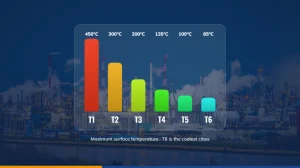
- Is the temperature class (T1–T6) suitable for the ignition temperature of the substance on site?
- Do the EU declaration of conformity and, where required, the EU-type examination certificate refer to 2014/34/EU?
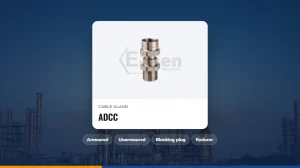
- Are accessories such as cable glands, blanking plugs and reducers suitable for the same protection type and certificate as the enclosure?
The right product with Eksen Mühendislik
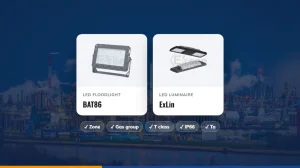
If you share the zone information from your explosion protection document, we can select the equipment together. Our ex-proof lighting, control stations, plugs, sockets and combination panels and ex-proof connection accessories pages show the category, EPL and temperature class of each product. For any questions, reach us via our contact page.
Sources
- European Commission: Equipment for potentially explosive atmospheres (ATEX)
- Directive 2014/34/EU (EU text on legislation.gov.uk): Articles 13, 16, 43 and Annex II
- Directive 1999/92/EC (EU text on legislation.gov.uk): Article 8, Annexes I, II and III
- Official Gazette 30.06.2016, No. 29758: Regulation on Equipment and Protective Systems Intended for Use in Potentially Explosive Atmospheres (2014/34/EU) (in Turkish)
- Official Gazette 30.04.2013, No. 28633: Regulation on the Protection of Workers from the Risks of Explosive Atmospheres (in Turkish)
- U.S. Bureau of Mines, Bulletin 680: Investigation of Fire and Explosion Accidents in the Chemical, Mining, and Fuel-Related Industries (Kuchta, 1985)
 Home
 Products
 Whatsapp
 Sidebar
 Top