


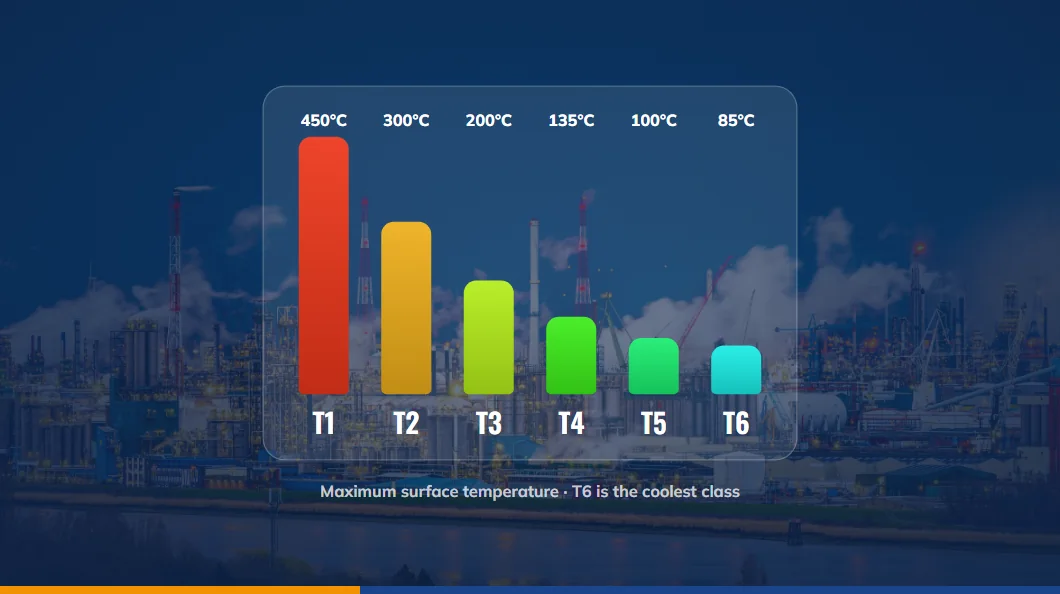
A spark is not needed to ignite an explosive atmosphere; a sufficiently hot surface can also be an ignition source. For this reason, the marking of ex-proof equipment includes a temperature class that shows the maximum temperature any of its surfaces can reach. To choose the right class, you need to know the ignition temperature of the gas or dust on site and the ambient temperature in which the equipment will operate.
What does the temperature class indicate?
For equipment used in gas atmospheres, the temperature class is given from T1 to T6. Each class is a limit on the highest temperature that any surface of the equipment can reach. The higher the class number, the lower the permitted surface temperature.
| Temperature class | Maximum surface temperature | Suitable for gases with an ignition temperature of |
|---|---|---|
| T1 | 450 °C | above 450 °C |
| T2 | 300 °C | above 300 °C, up to 450 °C |
| T3 | 200 °C | above 200 °C, up to 300 °C |
| T4 | 135 °C | above 135 °C, up to 200 °C |
| T5 | 100 °C | above 100 °C, up to 135 °C |
| T6 | 85 °C | above 85 °C, up to 100 °C |
The table is based on the temperature class table in the explosive atmospheres implementation guide of the Turkish Ministry of Labour and Social Security.
Relationship with ignition temperature
The ignition temperature is the lowest temperature at which a mixture of a flammable gas, vapour or dust with air ignites under specified conditions. Some sources call it the auto-ignition temperature. The rule is simple: the value of the equipment's temperature class must stay below the ignition temperature of the gas on site.
A higher-numbered class is always on the safe side. For example, if the site requires T4 (surfaces become dangerous from 135 °C), equipment marked T4, T5 or T6 can be used; equipment marked T3 cannot. If several gases are present on site, the class is determined by the gas with the lowest ignition temperature.
Ignition temperature and class of common gases
The table below gives the values and classes published by INERIS, the French national institute for industrial environment and risks. For comparison, the values from the International Chemical Safety Cards (ICSC) of the International Labour Organization (ILO) and the World Health Organization are also included.
| Substance | Ignition temperature (INERIS) | Ignition temperature (ICSC) | Temperature class |
|---|---|---|---|
| Methane | 600 °C | 537 °C | T1 |
| Hydrogen | 560 °C | 560 °C | T1 |
| Ethylene | 440 °C | 440 °C | T2 |
| Acetylene | 305 °C | 305 °C | T2 |
| Kerosene | 210 °C | 210 °C | T3 |
| Diethyl ether | 175 °C | 160–180 °C | T4 |
| Carbon disulphide | 90 °C | 90 °C | T6 |
Note two points:
- Values can vary from source to source. For methane, the difference between the two sources is 60 °C; the ignition temperature depends on the test method. For design, use the values in the substance's safety data sheet and in ISO/IEC 80079-20-1, the standard that gives the properties of gases and vapours.
- Temperature class and gas group are different things. Hydrogen has a high ignition temperature and falls into T1; however, it is in gas group IIC, which means it can be ignited by a very low spark energy. Carbon disulphide is both in group IIC and in class T6. Both are checked together when selecting equipment.
The T value for dust and layer thickness
For dust atmospheres, the equipment is marked with its maximum surface temperature directly in degrees instead of a T1–T6 class, for example T80°C or T130°C. Dust has two separate ignition temperatures: the ignition temperature of a dust cloud and the ignition temperature of a dust layer deposited on a surface.
According to the rule summarised by INERIS, the maximum surface temperature of the equipment must meet both conditions at the same time:
- It must be lower than two thirds of the ignition temperature of the dust cloud.
- It must be lower than the ignition temperature of a 5 mm dust layer minus 75 K (75 °C).
A hypothetical example: for a dust with a cloud ignition temperature of 450 °C and a 5 mm layer ignition temperature of 300 °C, the first condition gives a limit of 300 °C and the second a limit of 225 °C. The lower value applies; the value in the equipment marking must be below 225 °C.
The situation changes as the layer gets thicker. According to HSE, the temperature needed to ignite a dust layer depends on the layer's thickness and contact time; the Ministry guide also states that a dust layer retains heat through its insulating effect and increases the likelihood of ignition. For this reason, locations where deposits thicker than 5 mm are expected should be assessed separately, and the best measure is to prevent layers from forming through regular cleaning.
How does ambient temperature (Tamb) change the class?
The surface temperature of equipment depends on the heat it generates plus the temperature of the surrounding air. This is why a temperature class always applies to a stated ambient temperature range.
According to IEC 60079-0, unless another value is given in the marking, the normal ambient temperature range of equipment is −20 °C to +40 °C. The 8th edition of the standard, published in 2026, requires the rated ambient temperature range to be included in the product marking, on the grounds that the +40 °C upper limit is no longer sufficient in many parts of the world.
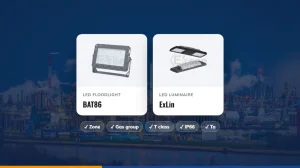
The BAT86 ex-proof LED floodlight on our site is a good example. According to its IECEx certificate (IECEx CQM 21.0015X):
| Ambient temperature | Gas | Dust |
|---|---|---|
| −60 °C … +40 °C | T6 | T80°C |
| −60 °C … +60 °C | T5 or T4 (depending on enclosure and power) | T95°C or T130°C (depending on enclosure and power) |
In other words, the same floodlight can be used for a gas requiring T6 on a site with ambient temperatures up to +40 °C, while on a site that can reach +60 °C the higher-power models drop to class T4. That is why the product marking shows the range T6…T4. On the product page, the “Sahanıza uygun mu?” (Right for your site?) table shows the ambient temperature range and temperature class, and the “Ex işaretinin anlamı” (What the Ex marking means) section explains each part of the marking.
Step-by-step selection
- Find the gases or dusts present on site and the zone from the explosion protection document.
- For gases, find the lowest ignition temperature and choose a temperature class that stays below this value.
- For dusts, calculate the maximum permitted surface temperature from the cloud and 5 mm layer ignition temperatures.
- Determine the lowest and highest ambient temperatures on site and check the temperature class given for that range in the product certificate.
- If the certificate number ends with X, read the specific conditions of use.
The right product with Eksen Mühendislik
Together with the zone and the gas group, the temperature class is one of the three key pieces of information for product selection. On the ex-proof lighting, plugs, sockets and combination panels and control, distribution and junction boxes pages, you can see the ambient temperature range and temperature class of each product. For the energy side of ignition, see our article What is minimum ignition energy (MIE)?, and for your site you can contact us.
Sources
- Republic of Türkiye Ministry of Labour and Social Security, Implementation Guide on the Protection of Workers from the Hazards of Explosive Atmospheres (in Turkish)
- INERIS, poster on the ATEX and IECEx certification schemes
- ILO, ICSC 0291: Methane
- ILO, ICSC 0001: Hydrogen
- ILO, ICSC 0475: Ethylene
- ILO, ICSC 0089: Acetylene
- ILO, ICSC 0663: Kerosene
- ILO, ICSC 0355: Diethyl ether
- ILO, ICSC 0022: Carbon disulphide
- IEC 60079-0:2026 preview pages (IEC)
- BARTEC, Overview of Explosion Protection Techniques, IECEx International Conference 2018 (iecex.com)
- HSE, Hazardous Area Classification and Control of Ignition Sources
 Home
 Products
 Whatsapp
 Sidebar
 Top